Use of FT-NIR Spectroscopy in Fuel Ethanol Industry
Introduction
Ethanol is a renewable fuel made from a variety of plant feedstocks, grains and starches. Since the United States has an abundant supply of corn (its number one crop), most of the ethanol produced in the US is made from corn. The Clear Air Act (1970/1990) mandates the addition of oxygenates (such as ethanol) to lower carbon monoxide emissions, reducing air pollution. Utilizing ethanol as a fuel additive reduces greenhouse gas emissions by up to 59 percent relative to gasoline. According to the U.S. Energy Information Administration, weekly ethanol production averaged 1.02 billion barrels per day during the first six months of 2017; up 5% from the same period in 2016. The U.S. Department of Energy states that nearly 97% of gasoline containing ethanol is classified as E10 (10% ethanol, 90% gasoline), which requires no special fueling equipment, and can be used in any conventional gasoline engine.
Ethanol production has steadily increased since the 1980s and continues to grow as the U.S. works to reduce its dependency on foreign energy supplies. As such, quality control has become a top priority for ethanol producers. Process improvements is areas such as dry milling, fermentation, and distillation are being implemented throughout the industry.
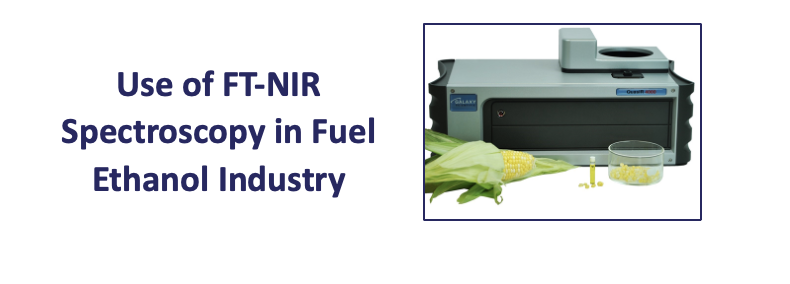
In the past decade, near infrared (NIR) spectroscopy has been successfully utilized in the fuel ethanol industry in the following principal areas: monitoring the quality of incoming grains; fermentation process monitoring; distillate analysis; and blending and dry house operation.
Compared with traditional methods, such as wet chemistry and HPLC, NIR spectroscopy provides considerable advantages in fuel ethanol quality control applications, such as:
- Eliminates costly consumables such as solvents, columns, and reagents
- Provides extremely fast results; generally less than 1 minute measurement time per sample
- Allows simultaneous analysis of multiple components per sample
- Effectively eliminates sample preparation time
- Eliminates many sources of systematic errors due to sample preparation and instrument misuse
OUR PORTFOLIO